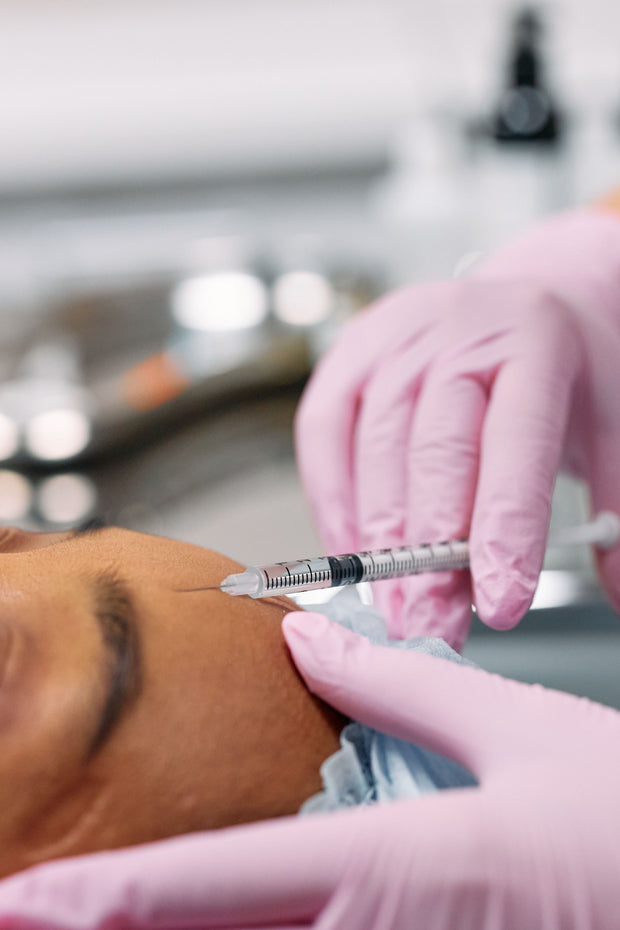

Skin Boosters vs Dermal Fillers: Choosing the Right Tool for the Job
“Skin booster” and “dermal filler” are often used loosely, sometimes interchangeably — but they do quite different jobs, and choosing the right one for the goal in front of you is fundamental to good results. Both are commonly based on hyaluronic acid, yet where they sit, how they behave and what they are for could hardly be more distinct.
What dermal fillers do
Dermal fillers are designed to add volume and provide structure. Placed in deeper planes, a firmer, more cohesive filler lifts and shapes — restoring cheek volume, defining a jawline, projecting a chin or smoothing a deep fold. Their value lies in holding their shape and supporting tissue where volume has been lost. The question a filler answers is broadly: where do we need more support or projection?
What skin boosters do
Skin boosters answer a different question: how do we improve the quality of the skin itself? Rather than adding shape, they are placed more superficially to hydrate and to stimulate the skin’s own production of collagen and elastin, improving texture, glow and firmness over a course of treatments. Injectable stabilised hyaluronic acid skin-quality boosters are recognised in expert consensus as a distinct category from volumising fillers — they treat the canvas, not the contours.
Where regenerative injectables fit
Alongside HA skin boosters sit regenerative options such as polynucleotides, which work by supporting repair and tissue quality rather than volumising. For many patients, skin-quality treatments like these form the foundation layer of a plan — improving the skin before, or as well as, any structural work with filler.
Choosing the right tool
The choice follows the diagnosis. If the concern is lost volume, sagging or lack of definition, structure is needed — a filler. If the concern is dull, crepey, dehydrated or ageing skin with good underlying structure, quality is needed — a skin booster or regenerative treatment. Many patients benefit from both, sequenced sensibly, but they are not substitutes for one another, and treating a skin-quality problem with volume (or vice versa) is a common route to a disappointing result.
Set expectations accordingly
Because they work differently, they deliver differently. Fillers show an immediate structural change; skin boosters and regenerative treatments build gradually over a course and reward patience. Explaining that distinction up front is key to a happy patient — someone expecting instant plumping from a skin booster, or glowing skin from a volumising filler, will feel let down by an otherwise excellent result.
A simple rule of thumb
If you are trying to change the shape of the face, think filler. If you are trying to change the condition of the skin, think skin booster or regenerative injectable. It is a deliberate simplification — but as a starting point for the conversation with your patient, it rarely steers you wrong.
Understand the difference and you prescribe better: fillers for structure, skin boosters and regenerative injectables for quality, and thoughtful combinations where the face needs both. Matching the tool to the job is where good outcomes begin.
References
- Injectable Non-Animal Stabilized Hyaluronic Acid as a Skin Quality Booster: An Expert Panel Consensus. Journal of Drugs in Dermatology.
- Multimodal skin rejuvenation with Restylane skin boosters (non-animal stabilised hyaluronic acid): a case series. Cosmoderma.
- Efficacy and safety of a resilient hyaluronic acid dermal filler in nasolabial folds: a randomized study. Journal of Cosmetic Dermatology. 2020.
- Squadrito F, et al. Pharmacological Activity and Clinical Use of PDRN. Frontiers in Pharmacology. 2017;8:224.

Dr Emmaline Ashley
Aesthetic Doctor · GMC 7582958 · COO of Harley Supplies
Dr Emmaline Ashley is an aesthetic doctor and published researcher in aesthetic medicine, with peer-reviewed work spanning product safety, regenerative treatments and medical education. She is a member of the Acquisition Aesthetics clinical faculty.